
Ask Your Power BI Usage Anything: The BI Pixie MCP Server is in Public Preview
Connect Claude, Copilot, Fabric data agents, and Azure AI Foundry to your BI Pixie data and ask how your Power BI reports are really used, in plain language. The BI Pixie MCP Server is now in public preview, with both a local install and a hosted option.
Your AI assistant can already write DAX, summarize a model, and draft a report. What it could not do, until now, is tell you how your Power BI reports are actually used. That changes today.
The BI Pixie MCP Server is now in public preview. It lets AI assistants such as Claude, GitHub Copilot, Codex, Microsoft Fabric data agents, and Azure AI Foundry answer questions about your Power BI adoption and engagement, in plain language. It connects to your BI Pixie semantic model and returns numbers that match your BI Pixie Dashboard exactly. It is strictly read-only, so it can never change, delete, or refresh your data.
What is MCP?
The Model Context Protocol is an open standard for connecting AI assistants to tools and data. The BI Pixie MCP Server is one such tool. Once you register it with your assistant, you can ask usage questions in chat and the assistant pulls the answers straight from your BI Pixie data, with no DAX and no exports.
What you can ask
Once connected, you can ask your assistant questions like:
- “Which of my reports are used the most? Which are unused and could be retired?”
- “How many monthly and daily active users do I have, and what is my stickiness (DAU/MAU)?”
- “Which pages in the Executive Dashboard get the most clicks and time spent?”
- “What is my CSAT and NPS, and which reports are dragging satisfaction down?”
- “How has adoption trended over the last 90 days?”
- “How much time savings and financial benefit have users reported in surveys?”
Not sure where to begin? Ask your assistant to “suggest questions” and it returns a built-in menu of examples grouped by topic.
Two ways to run it
You can run the server two ways. Almost everyone starts with the local install, then deploys the hosted option to run it in production for AI agents and teams.
Local: start here
Install it on your own machine and sign in as yourself. You are asking questions within minutes, with no service principal and no admin setup beyond a single tenant setting. There is no download or clone; it ships on PyPI:
# Zero-install runner (recommended), always fetches the latest version:
uvx bipixie-mcp

# Or install into your current Python environment:
pip install bipixie-mcp
The local install runs entirely under your own Power BI identity, so it can only reach data you already have access to. Point it at a workspace and the BI Pixie model with a few environment variables, sign in once with the Azure CLI, and your assistant is connected. You can even switch between BI Pixie models mid-chat just by asking.
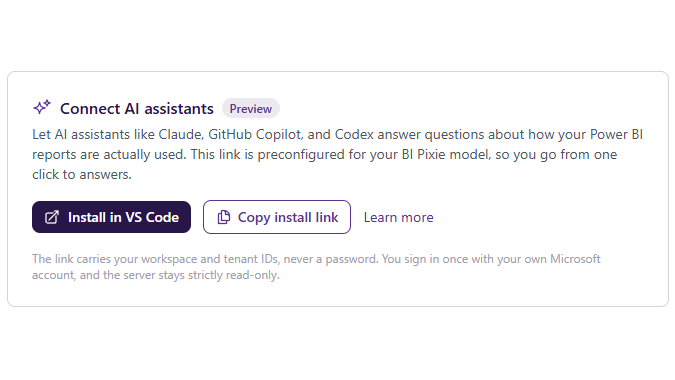
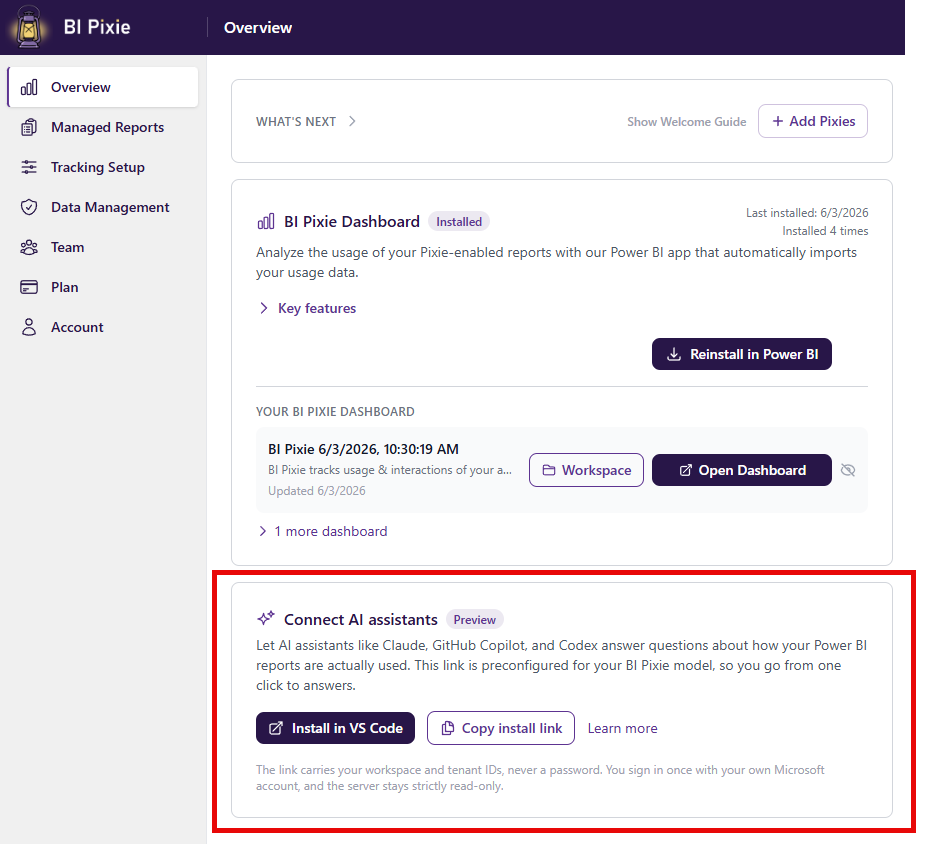
Already a BI Pixie customer? You can skip the manual setup. Open the Overview page in the BI Pixie portal and click Install in VS Code on the Connect AI assistants card. The link is preconfigured for your BI Pixie model, so you go from one click to answers.
Hosted: run it in production
The same server can run hosted in your Azure environment as a secure, always-on endpoint. That is what lets AI agents in production workflows query usage data on their own, and what lets Microsoft Fabric data agents, Azure AI Foundry, and your whole team reach it without anyone installing anything locally. The hosted path runs under a managed identity or service principal rather than a personal sign-in. It is an enterprise setup, and our team will help you plan it.
Ground your data agents in real usage
The hosted option unlocks one of our favorite use cases. When a data agent turns a question into DAX against a mission-critical model, it has to guess which column and which value the user means. Point it at the BI Pixie MCP Server first: it can rank columns by how often people actually select and filter them, and return a column’s most-selected values, so the agent picks the column and the values real users rely on instead of guessing.
Works with every BI Pixie deployment
The MCP Server is not tied to one edition. It queries the BI Pixie semantic model, and every deployment of BI Pixie produces that same model. So it works with:
- BI Pixie Cloud, the default SaaS service.
- BI Pixie Self-Hosted, whether you run it on Azure or on Power Platform.
- BI Pixie Workload for Microsoft Fabric, now in public preview.
Wherever your BI Pixie data lives, your AI assistant can ask it questions.
Private and secure by design
- Read-only. The server can only run read queries. Write commands are rejected before they reach Power BI.
- Runs as you. The local install uses your own Microsoft sign-in, so it can only reach data you are already permitted to see.
- No personal data by default. User names and IP addresses are stripped from every result unless an administrator explicitly enables them after a privacy review.
- Numbers you can trust. Answers come from the same validated measures as your BI Pixie Dashboard, and every answer is stamped with how fresh the data is.
Get started
The full setup guide walks through installing, configuring, and registering the server with your assistant in a few minutes.
You can also browse the package, every setting, and the complete tool catalog on bipixie-mcp on PyPI. Questions about the hosted option? Contact us and we will help you plan it.