Skip to content
Feature

AI Readiness for Fabric Data Agents, and A/B Tests

BI Pixie now assesses your Fabric data agents based on Microsoft's published guidance, applies the fixes it can make to the data agent, and lets you test each change with an A/B test. The first assessment is free, for up to 500 semantic models and data agents in your account.
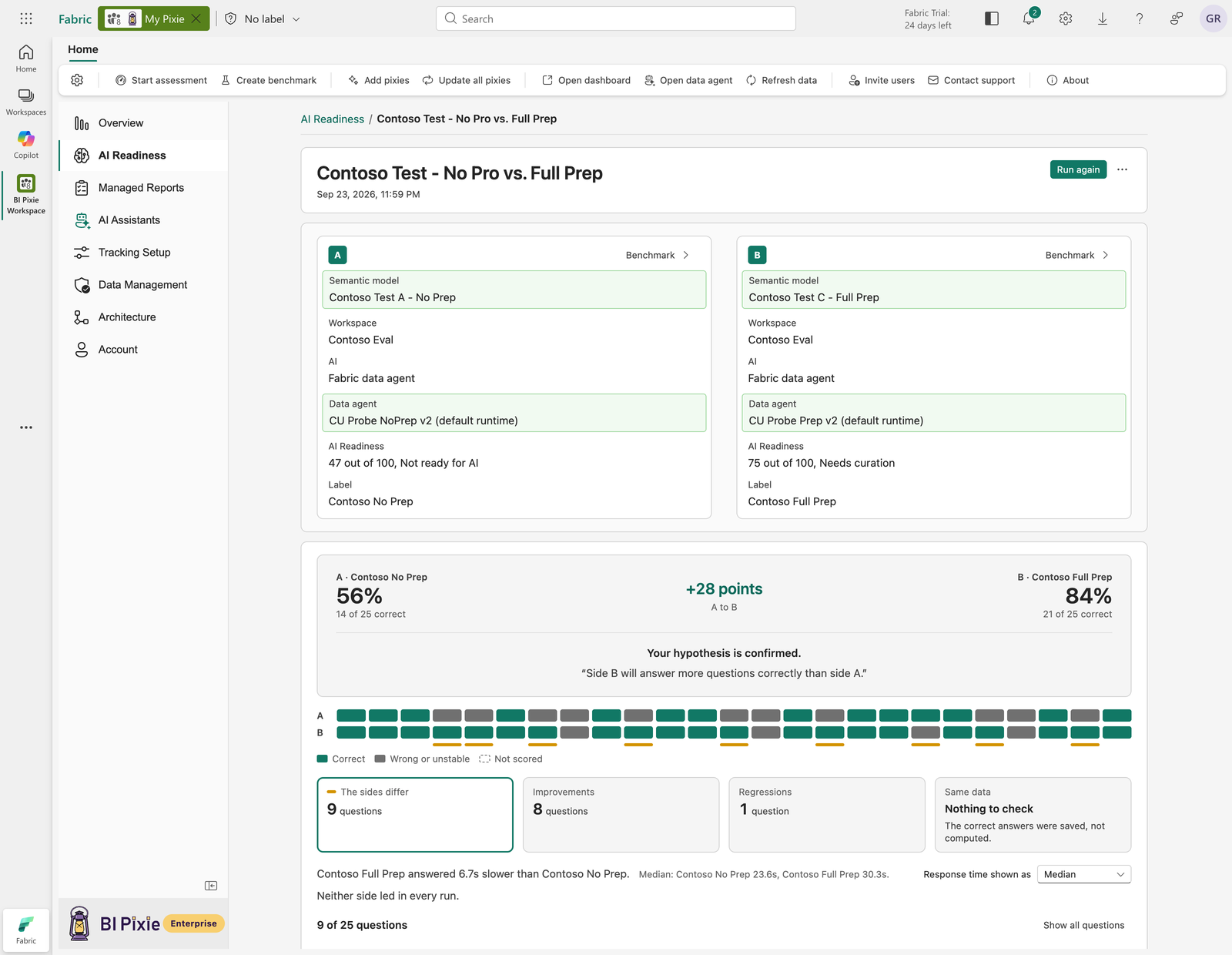
An A/B test result in the BI Pixie Workload for Microsoft Fabric, headed Contoso Test - No Pro vs. Full Prep. Two side cards name each side's semantic model, workspace, AI, data agent and AI Readiness: side A is Contoso Test A - No Prep, 47 out of 100, Not ready for AI, and side B is Contoso Test C - Full Prep, 75 out of 100, Needs curation. Side A answered 56 percent of the questions correctly, 14 of 25, and side B answered 84 percent correctly, 21 of 25, a difference of 28 points from A to B, and the verdict reads Your hypothesis is confirmed under the hypothesis that side B will answer more questions correctly than side A. A paired strip shows all 25 questions for both sides, above four tiles: the sides differ on 9 questions, 8 improvements, 1 regression, and Same data reads Nothing to check because the correct answers were saved rather than computed. Under the tiles BI Pixie reports that side B answered 6.7 seconds slower than side A, with median response times of 23.6 seconds for side A and 30.3 seconds for side B.
BI Pixie AI Readiness Fabric Data Agents A/B Tests AI Benchmarks Microsoft Fabric Power BI Copilot Semantic Model

Your organization wants Power BI Copilot and Fabric data agents in production, answering real business questions for the people who run the business.

How do you get AI Readiness at scale? An organization rarely stops at one data agent. Each team builds its own, on a different mix of semantic models, lakehouses, warehouses, KQL, SQL and mirrored databases, and you need one standard that tells you where each of them stands. You also need a process that keeps the answers correct as data agents change, and tells you whether each change your team makes, and each update Microsoft makes to the AI behind them, really improves the answers. BI Pixie gives you that process in three steps: assess, apply and test.

Last month we introduced AI Readiness for semantic models, which lets you assess your semantic models, fix and optimize them, and then generate effective benchmarks that test your AI, and run those benchmarks over time to catch regressions. Today BI Pixie extends AI Readiness. You can now assess data agents and apply optimizations to them. Then you can run A/B tests that compare two versions of your semantic model, or of the AI that queries it. With A/B tests, you stop guessing whether a change made your AI more accurate.

The new capabilities are available in BI Pixie Cloud and in the BI Pixie Workload for Microsoft Fabric. The screens in this post are from the Workload.

Assess a Fabric data agent

The data agents your teams build each get one AI Readiness score, based on Microsoft’s published guidance for data agents. You see which data agents are ready to answer, which findings lower each data agent’s score, and when a data agent’s score rises or falls, so data agents built by different teams are held to the same standard. Where the semantic models underneath are what limit a data agent, BI Pixie says so, and the work goes to the semantic model rather than to the data agent.
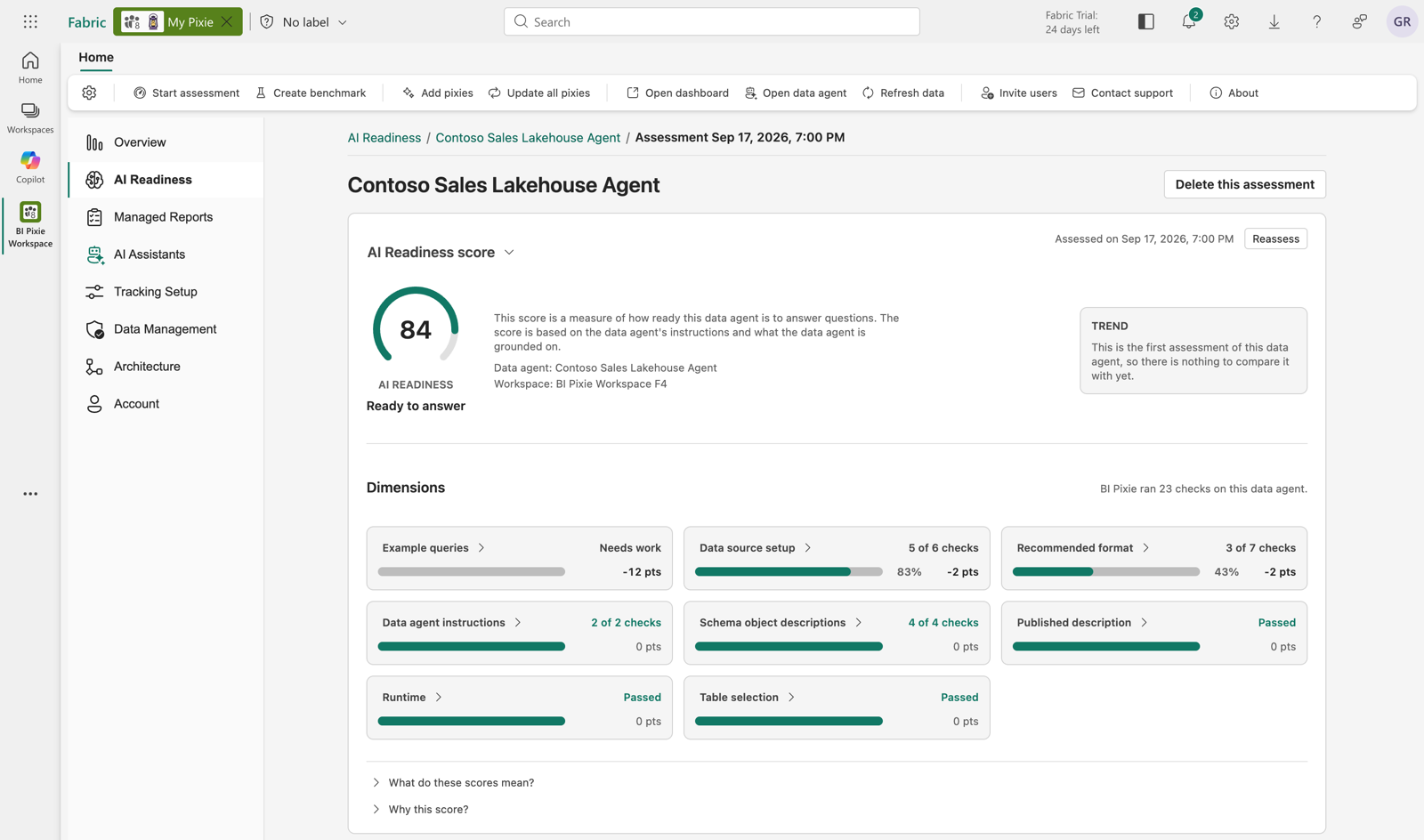
The AI Readiness score card for a Fabric data agent in the BI Pixie Workload for Microsoft Fabric. The data agent is named Contoso Sales Lakehouse Agent and sits in the BI Pixie Workspace F4 workspace, assessed on September 17, 2026. The score reads 84, AI Readiness, Ready to answer, beside a trend panel saying this is the first assessment of this data agent, so there is nothing to compare it with yet. Under Dimensions, BI Pixie ran 23 checks and shows eight tiles ordered by what each one costs the score. Example queries reads Needs work and 12 points lost. Data source setup passed 5 of 6 checks, 83 percent, and lost 2 points. Recommended format passed 3 of 7 checks, 43 percent, and lost 2 points. Data agent instructions passed 2 of 2 checks, Schema object descriptions passed 4 of 4 checks, and Published description, Runtime and Table selection all read Passed, each costing nothing. Below the tiles sit two questions the reader can open, What do these scores mean and Why this score.
One score for the data agent, with what costs it the most at the top.
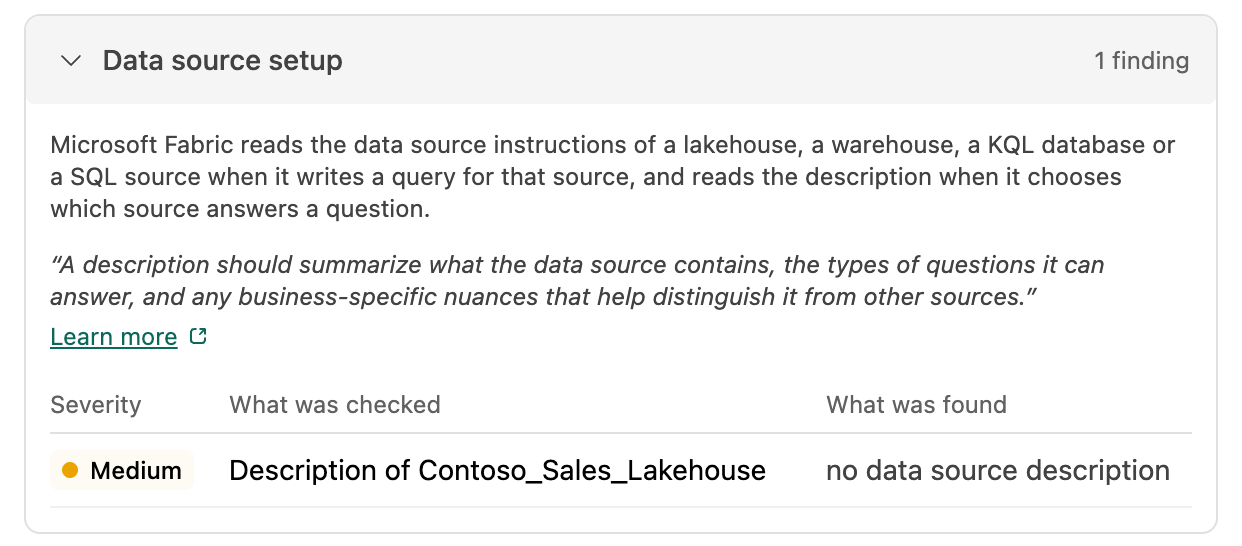
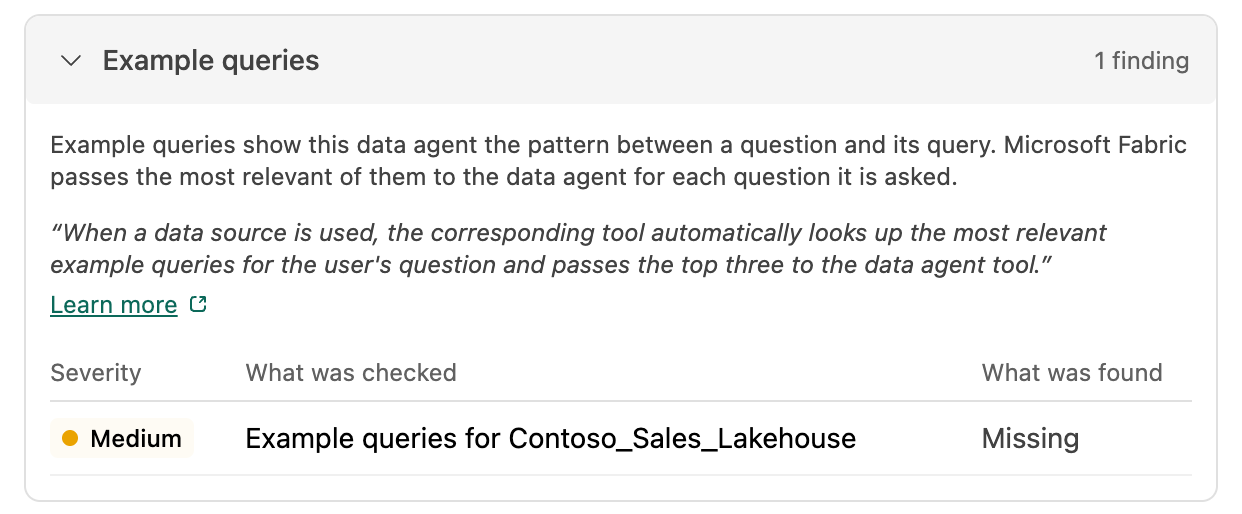
An opened finding in the BI Pixie Workload for Microsoft Fabric, headed Example queries, 1 finding. BI Pixie explains that example queries show this data agent the pattern between a question and its query, and that Microsoft Fabric passes the most relevant of them to the data agent for each question it is asked. Microsoft's own words follow in quotation marks: when a data source is used, the corresponding tool automatically looks up the most relevant example queries for the user's question and passes the top three to the data agent tool. A Learn more link opens Microsoft's page in a new tab. A table below it gives the severity, what was checked and what was found: Medium, Example queries for Contoso_Sales_Lakehouse, Missing. An opened finding in the BI Pixie Workload for Microsoft Fabric, headed Data source setup, 1 finding. BI Pixie explains that Microsoft Fabric reads the data source instructions of a lakehouse, a warehouse, a KQL database or a SQL source when it writes a query for that source, and reads the description when it chooses which source answers a question. Microsoft's own words follow in quotation marks: a description should summarize what the data source contains, the types of questions it can answer, and any business-specific nuances that help distinguish it from other sources. A Learn more link opens Microsoft's page in a new tab. A table below it gives the severity, what was checked and what was found: Medium, Description of Contoso_Sales_Lakehouse, no data source description.
Open a finding and you see Microsoft's own words beside what BI Pixie found on your data agent.

You are not limited to data agents built on semantic models. BI Pixie assesses every source a data agent is grounded on, from lakehouses and warehouses to KQL, SQL and mirrored databases, and compares each one with Microsoft’s published guidance for that kind of source, so what you see covers the whole data agent.

Apply what the assessment finds

You turn the assessment’s findings into changes that your own AI writes, then review and publish the ones you want. Nothing reaches the data agent until you approve it, and you can assess the data agent again afterwards, so you can see what each fix changed. Need this reassessment on a schedule? On the Enterprise plan, you can add data agent assessments to a schedule side by side with your semantic model assessments.
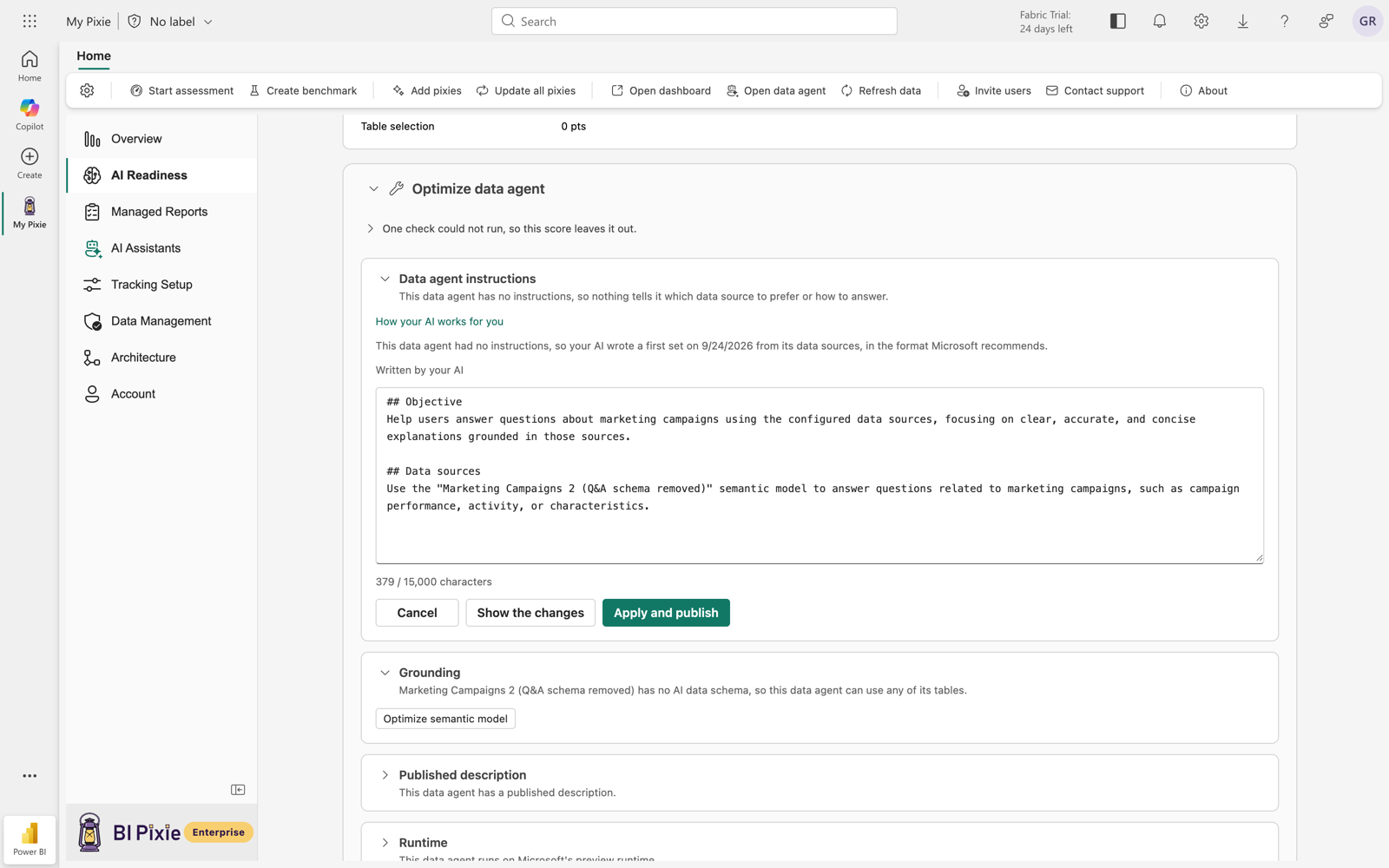
The Optimize data agent card in the BI Pixie Workload for Microsoft Fabric. The Data agent instructions card says this data agent has no instructions, so nothing tells it which data source to prefer or how to answer, and offers the link How your AI works for you. Your AI wrote a first set from the data sources in the format Microsoft recommends, shown under Written by your AI with an Objective section and a Data sources section naming the semantic model, a count of 379 of 15,000 characters under the box, and the Cancel, Show the changes, and Apply and publish buttons below that. The Grounding card follows, saying the semantic model has no AI data schema so the data agent can use any of its tables, then the Published description and Runtime cards.
Your AI drafts the change, and nothing reaches the data agent until you approve it.

Test each change with an A/B test

You can apply two sensible optimizations and find that only one of them improved your AI’s answers. With an A/B test you put each optimization to the test: you run the same benchmark before the change and after it, and BI Pixie checks each answer against the correct answer computed from your own data. You state a hypothesis, for example that the semantic model you prepared answers more questions correctly, and you see whether it holds, question by question.

An A/B test result in the BI Pixie Workload for Microsoft Fabric, headed Contoso Test - No Pro vs. Full Prep. Two side cards name each side's semantic model, workspace, AI, data agent and AI Readiness: side A is Contoso Test A - No Prep, 47 out of 100, Not ready for AI, and side B is Contoso Test C - Full Prep, 75 out of 100, Needs curation. Side A answered 56 percent of the questions correctly, 14 of 25, and side B answered 84 percent correctly, 21 of 25, a difference of 28 points from A to B, and the verdict reads Your hypothesis is confirmed under the hypothesis that side B will answer more questions correctly than side A. A paired strip shows all 25 questions for both sides, above four tiles: the sides differ on 9 questions, 8 improvements, 1 regression, and Same data reads Nothing to check because the correct answers were saved rather than computed. Under the tiles BI Pixie reports that side B answered 6.7 seconds slower than side A, with median response times of 23.6 seconds for side A and 30.3 seconds for side B.
Side B answered 84 percent of the questions correctly and side A 56 percent, which confirms the hypothesis that side B would answer more questions correctly.

With A/B tests, every optimization your team keeps is one that measurably made your AI more accurate.

Start with a free first look

The first assessment is free, for up to 500 semantic models and data agents together, so you know where your mission-critical semantic models and data agents stand for AI. The Free plan also includes one A/B test run, so you can put your first optimization to the test.

Learn more

Start BI Pixie FREE plan today, or if you prefer to run it on Fabric, ask your Power BI admin to approve the BI Pixie workload in the Fabric Workload Hub.