
Data Management
Measuring how your audience uses your Power BI reports helps you deliver better BI solutions. In Data Management, you control the data that BI Pixie collects for you.
When end users, the people who consume your Power BI reports, ask to be forgotten, or when auditors need proof of data governance, Data Management is where you respond. You can set retention periods, search for the events of a specific end user, and delete activity records yourself, without a support ticket.
In the BI Pixie item, select Data Management from the sidebar to access these controls.
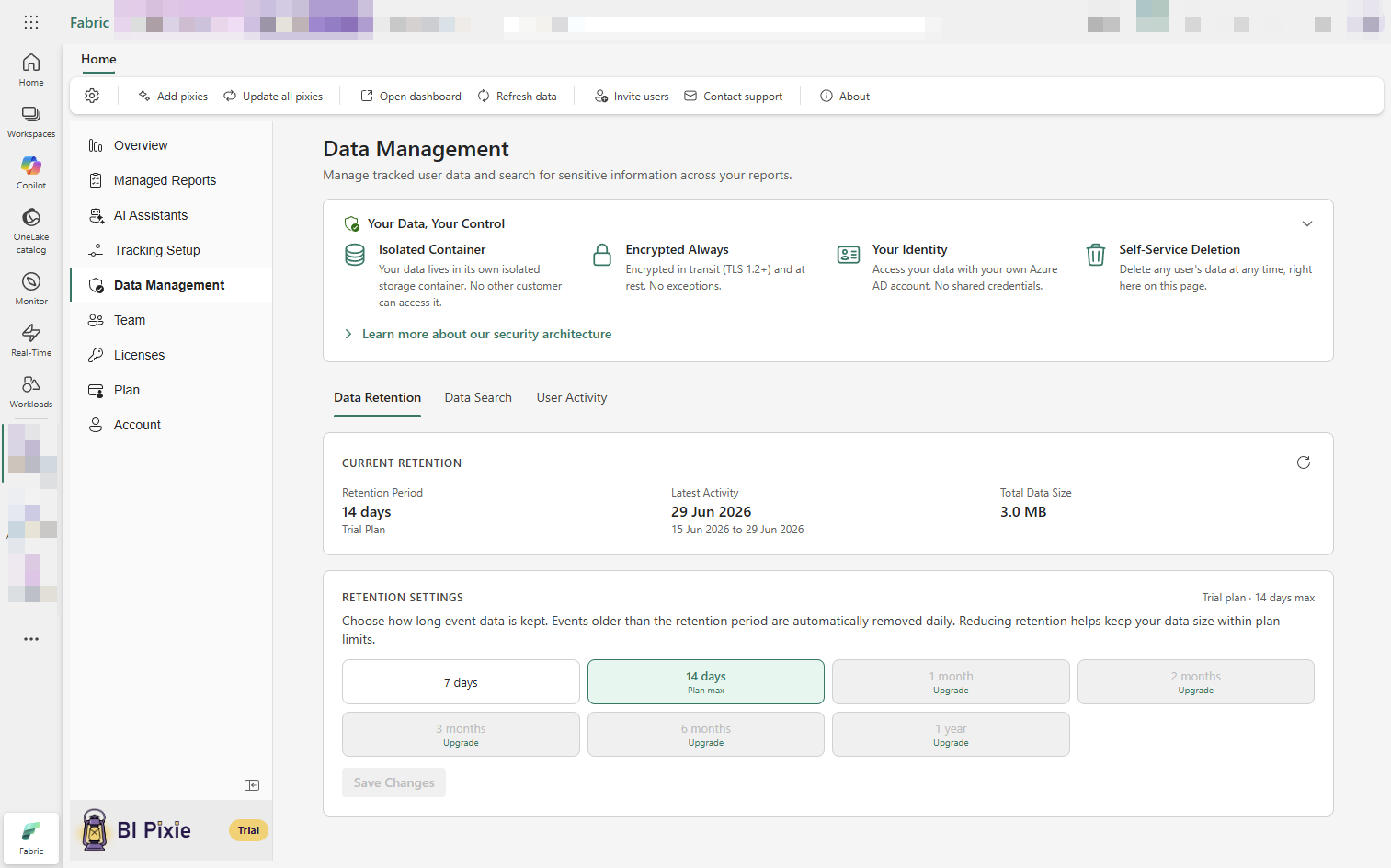
Data Retention
On the Data Retention tab, you view and set how long BI Pixie keeps your event data.
Current Retention
At the top you will see your current retention period, the date range of your event data, and total data size.
If you have turned on Data residency so events are delivered to your own OneLake, the latest activity and data size read In your OneLake instead, because the volume and dates are tracked in your lakehouse rather than the BI Pixie cloud.
Changing the Retention Period
The available retention options depend on your subscription:
| Subscription | Available Options | Maximum |
|---|---|---|
| Free | 7, 14, 30 days | 30 days |
| Standard | 7, 14, 30 days | 30 days |
| Pro | 7, 14, 30, 60, 90, 180, 365 days | 365 days (1 year) |
| Enterprise | 7, 14, 30, 60, 90, 180, 365, 730, 1095 days | 1095 days (3 years) |
To change the retention period, choose a new value and select Save Changes. If you reduce the period, BI Pixie asks you to confirm, because events older than the new period are permanently deleted during the next daily cleanup.
Data Search
On the Data Search tab, you find and manage specific event data. You can use Data Search to respond to data subject access requests or to investigate end user activity.
Search Steps
- Select a report from the dropdown. You can also delete all events for a report from here.
- Select a user from the dropdown, which shows user identifiers and event counts.
- Choose a date range using preset buttons or custom date pickers. On the Free and Standard plans, the 7-day preset is the only one available. On the Pro plan and above, you can also use the longer presets and custom dates.
- Browse event files matching your criteria. You can preview any file, and on the Pro plan and above you can delete individual files.
- Search across files on the Pro plan and above. Select up to 10 files and run a text search to find matching rows.
User Activity
On the User Activity tab, you see your tracked end users and can search, inspect, and delete their data.
BI Pixie shows a searchable list of users and how many users it tracked in the last 30 days. Each row displays the user identifier, number of reports they have interacted with, and event file count. To see the reports associated with a user, select the user's row.
Deleting User Data
To delete all data for a specific user:
- Select Delete next to the user.
- Confirm in the dialog. All activity data for that user across all reports is permanently deleted from BI Pixie's storage.
BI Pixie also removes the user's rows from your BI Pixie Dashboard when the dashboard next refreshes. BI Pixie records the deletion beside your events, and removes the user's activity from before the deletion from every table the next time the BI Pixie ETL notebook runs. BI Pixie removes that activity only when the dashboard is on its latest version, and BI Pixie offers each new version as an update on the Overview of the BI Pixie item. BI Pixie collects viewer user names only when you turn on Capture user identity, and you then choose on the Account page whether it keeps the email address, a masked ID or nothing. Until then, BI Pixie counts viewers by a masked IP address. Where BI Pixie knows a viewer only by a masked IP address, which several people can share, it keeps the session and click rows keyed on that address, which identify nobody. You do not need to run the BI Pixie User Erasure notebook for a user you deleted here. Two more things remain after the delete: BI Pixie keeps a safety copy of the deleted events for up to 90 days, after which it expires, and the user's sessions stay counted toward your fair-use session allowance, with nothing left that identifies them.
How your data flows, and what Data Management reaches
To understand exactly what the Data Management controls delete, you need to know where your telemetry lives. By default, your raw event data is stored in a dedicated, secured storage container in the BI Pixie cloud, and the BI Pixie Workload creates a shortcut to that container in your Fabric workspace. Your data flows through three layers:
- Raw event data in the dedicated, secured container in the BI Pixie cloud, surfaced into your workspace through a shortcut.
- Lakehouse tables, produced when the BI Pixie ETL notebook processes the raw events into curated Delta tables.
- BI Pixie Dashboard, which reads those Lakehouse tables through Direct Lake.
When you delete data in Data Management, BI Pixie deletes it from the raw event data in the dedicated container, because the raw event data is the source layer BI Pixie owns and can act on directly. The processed copies in the Lakehouse tables and the dashboard semantic model live on your own capacity. BI Pixie removes a user you delete from those processed copies when the dashboard next refreshes, because BI Pixie applies the deletion when the BI Pixie ETL notebook runs. Retention and other clean-ups of those processed layers are done with the Maintenance Notebooks.
With the Maintenance Notebooks, you can erase a person whose data the Data Management view cannot delete, for example on an account whose data is kept in your own OneLake, and you can enforce your retention window across all layers. You run the Maintenance Notebooks on your own capacity, under your own identity, and they cover the processed layers that the Data Management controls do not.
Prerequisites
Data Management requires an active BI Pixie subscription and a BI Pixie item created in your Fabric workspace. Data Residency describes where BI Pixie stores your telemetry.
What's Next
- BI Pixie Notebooks: The ETL that builds your dashboard data, plus complete cross-layer retention and GDPR erasure, all run from your own capacity.
- Team Access: How Microsoft Fabric workspace roles control access to BI Pixie.
- Licenses: Manage subscription tiers and license assignment.
- Account: View usage stats and subscription details.
- Contact Support: Get help with data management or compliance requests.